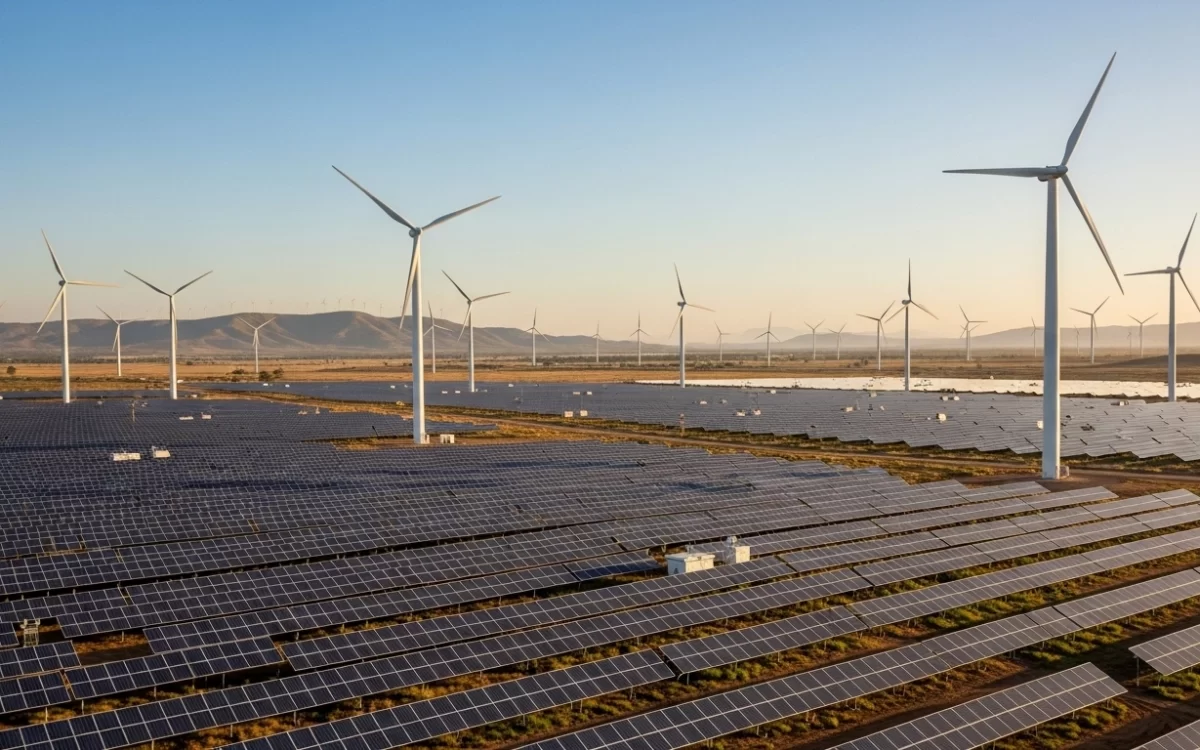
India has officially become the world’s third-largest producer of solar and wind power, surpassing Germany in a milestone that highlights its growing role in the global clean energy transition. According to Ember’s Global Electricity Review 2024, wind and solar together contributed 10% of India’s electricity generation, with solar alone accounting for 7%.
Solar power generation has doubled since 2021, and the country added 24.5 GW of solar capacity in 2024, more than twice the addition in the previous year. India now stands behind only China and the United States, recording the fourth-largest increase in solar generation globally, contributing an additional 20 TWh of solar electricity.
Rapid Growth in India’s Solar and Wind Power
India’s renewable energy sector has experienced unprecedented expansion. Strong policy support and strategic investments have driven solar and wind adoption across industrial, commercial, and utility-scale projects.
Key growth highlights include:
- Doubling of solar power generation since 2021
- 24.5 GW of solar capacity added in 2024
- Wind and solar together contributing 10% of total electricity generation
These achievements underscore India’s commitment to clean energy and its increasing influence on the global renewable energy market.
India’s Solar PV Manufacturing Expansion
India’s position in the global solar market is further reinforced by robust domestic manufacturing growth.
- Monocrystalline modules account for nearly 59% of production, followed by TOPCon, polycrystalline, and thin-film technologies
- The Ministry of New and Renewable Energy added 8,067 MW of module manufacturing capacity to the Approved List of Models and Manufacturers (ALMM) in March 2025
- Starting June 2026, solar cells will also fall under ALMM regulations, signaling enhanced quality and traceability
This expansion ensures that India’s solar and wind power growth is supported by a strong domestic supply chain, enabling faster deployment and more reliable project outcomes.
Renewable Energy Targets and Policy Support
India remains ambitious in its renewable energy objectives:
- 50% of installed electricity capacity to come from non-fossil fuel sources by 2030
- 500 GW of non-fossil fuel capacity targeted by 2030, announced during COP26
- Ongoing policy incentives, such as subsidies, tax benefits, and financing options, facilitate industrial and commercial adoption
These policies are critical to maintaining India’s upward trajectory in solar and wind power production.
Challenges in Scaling India’s Solar and Wind Power
Despite rapid growth, challenges remain:
- Rising electricity demand requires continuous scaling of renewable generation
- Funding must increase by at least 20% annually to meet 2030 targets (Ember, Feb 2025)
- Grid readiness and storage solutions need expansion to support intermittent solar and wind supply
Addressing these challenges is essential to ensure India’s clean energy goals are met efficiently and sustainably.
Conclusion: India’s Global Leadership in Solar and Wind Power
India’s achievements in solar and wind power mark a significant milestone in the global clean energy transition. With strong domestic manufacturing, policy support, and strategic investments, the country is well-positioned to maintain its rapid growth.
For companies and developers exploring renewable energy opportunities, REnergo Developers provides turnkey EPC and O&M solutions to efficiently harness solar and wind power across India.
For further insights on India’s renewable energy landscape, refer to this Ember report on global electricity.