
Smart Monitoring Systems in Modern Solar Plants
Industrial and utility-scale solar plants in India and Nepal increasingly rely on smart monitoring systems to maintain consistent performance. These systems combine IoT-enabled sensors, AI analytics, and predictive maintenance protocols. As a result, downtime is minimized, energy yield is optimized, and operational efficiency is sustained. For plant operators, adopting smart monitoring systems is no longer optional—it is a strategic necessity to protect financial and operational outcomes.
Why Predictive Monitoring Matters
Traditional reactive maintenance often leads to unplanned downtime and energy losses. In contrast, smart Traditional reactive maintenance can cause unexpected downtime and energy losses. In contrast, smart monitoring systems continuously collect real-time data from modules, inverters, and other components. Advanced analytics allow operators to:
- Detect underperforming strings or modules before they reduce output
- Forecast potential inverter or battery failures
- Optimize maintenance schedules to minimize disruption
By acting on these insights, operators can reduce downtime by up to 15% and maintain consistent energy production. Consequently, overall plant reliability and ROI improve significantly.
Advanced analytics allow operators to detect underperforming strings, forecast potential failures, and optimize maintenance schedules, improving reliability and financial outcomes. For global technical insights on smart monitoring, see IRENA’s report on digitalization of solar PV.
Components of Smart Monitoring Systems
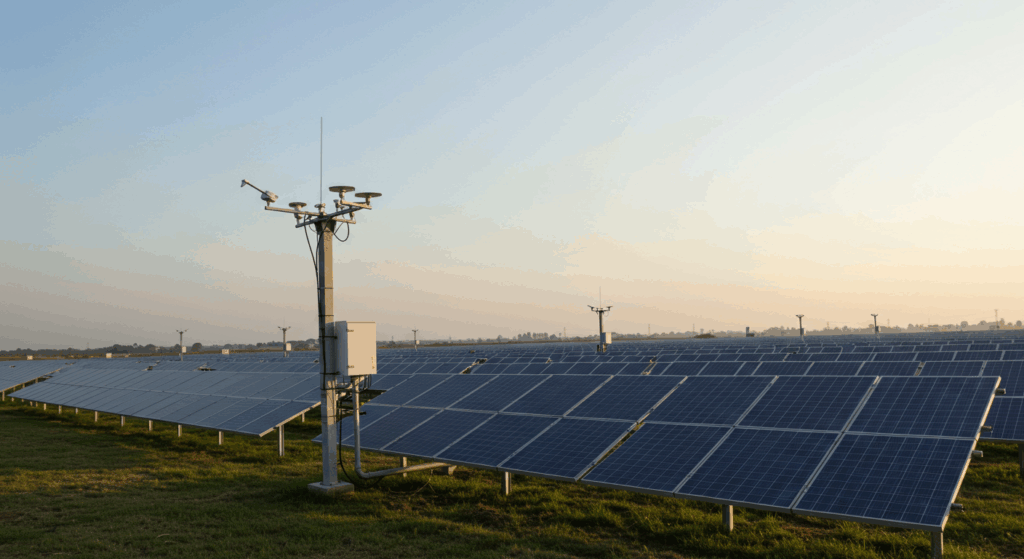
Smart monitoring systems integrate several technologies to maximize solar plant efficiency:
- IoT Sensors: Gather detailed performance metrics at module and string levels
- AI-Driven Analytics: Identify anomalies, predict component degradation, and recommend corrective actions
- Remote Management Platforms: Enable real-time oversight and rapid issue resolution
- Automated Alerts: Notify operators immediately of deviations to allow prompt intervention
Together, these elements improve operational resilience, maintain high efficiency, and reduce lifecycle O&M costs.es, plants achieve operational resilience, maintain high efficiency, and reduce lifecycle O&M costs.
Benefits for Industrial and Utility-Scale Plants
Implementing smart monitoring systems offers multiple advantages:
- Reduced Unplanned Downtime: Predictive insights minimize interruptions and maximize availability
- Improved Energy Yield: Early detection of underperformance ensures consistent production
- Extended Component Lifespan: Optimized maintenance prevents excessive wear
- Data-Driven Decisions: Operators gain actionable insights to enhance system performance and financial outcomes
In addition, linking monitoring strategies with advanced plant design such as hybrid solar systems or floating solar can further optimize energy capture and ROI. For related insights, see Hybrid Solar Systems: Unlock 8–15% More Energy and ROI.
Implementing Smart Monitoring Systems Effectively
To achieve 99% uptime, plant operators should integrate monitoring systems with broader operational strategies:
- Combine smart monitoring with preventive maintenance protocols for comprehensive plant reliability.
- Ensure proper calibration and placement of sensors for accurate data collection.
- Train operations teams to interpret analytics dashboards and respond efficiently.
- Continuously update AI models with local performance data to improve predictive accuracy.
By following these practices, plants maintain continuous operation even in challenging environmental conditions.
Maximizing ROI through Smart Monitoring
Adopting smart monitoring systems allows solar plants to:
- Maintain near-continuous operation even in challenging environments.
- Increase energy efficiency by detecting and correcting underperformance early.
- Optimize ROI through reduced downtime and extended component lifespan.
Enhance your solar plant’s reliability and efficiency by implementing smart monitoring systems. Explore expert strategies and practical guidance at REnergo’s blog library to maximize uptime and ROI.